Lost on Purpose: How a Wrong Turn Became the Best Part of My Trip

Photo: Underwood & Underwood, CC BY-SA 2.5, via Wikimedia Commons
There's a small taqueria in a strip mall outside Tucson that doesn't have a website, doesn't show up on Google Maps with any real prominence, and probably wouldn't make it onto any "Top 10 Eats in Arizona" listicle. But if you ask anyone who's stumbled across it — usually because they missed the highway on-ramp and ended up wandering a service road — they'll tell you it's one of the best meals they've ever had.
That's the thing about wrong turns. They have a habit of being right.
We're a culture obsessed with optimization. We pre-book, pre-research, pre-plan. We screenshot menus, screenshot maps, screenshot the screenshot. And while there's nothing wrong with a little preparation, we've quietly trained ourselves to treat uncertainty like a problem to be solved rather than a doorway worth walking through.
But some of the richest travel experiences alive today live just past the edge of your itinerary.
Why Your Brain Fights the Detour (And Why You Should Let It Lose)
Here's what's actually happening when you take a wrong turn and your stomach drops: your brain shifts into what psychologists call a heightened attentional state. You're suddenly more present. You're scanning your environment, noticing details, processing sensory input with a sharpness that cruise-controlled navigation simply doesn't trigger.
In other words, getting a little lost wakes you up.
Travelers who've made a habit of intentional wandering will tell you the same thing — there's a distinct quality of attention that kicks in when you don't know exactly where you are. Colors look more vivid. Sounds feel closer. You notice the hand-painted sign above the door, the smell coming from the bakery you almost walked past, the guy playing guitar in the alley who turns out to be locally famous.
Planned routes are efficient. But efficiency isn't the same thing as experience.
The Stories That Actually Get Told
Think about the last trip you took. Now think about the story you've told the most since you got back. Is it the thing you booked three months in advance? Or is it the thing that happened when something went sideways?
For most travelers, it's the latter. The missed train that stranded them in a small town where the locals invited them to a harvest festival. The wrong neighborhood that turned out to have the best street art they'd ever seen. The closed restaurant that sent them wandering until they found a hole-in-the-wall with a two-page menu and a line out the door.
These stories stick because they carry a quality that curated experiences often lack: genuine surprise. You can't manufacture that feeling. You can only leave room for it.
Practical Ways to Engineer a Happy Accident
So how do you actually build more of this into your travel without just wandering aimlessly and ending up frustrated?
Pick one navigation-free hour per day. You don't have to go full analog for your entire trip. Just designate a window — maybe after lunch, maybe on your first morning — where you put the phone away and walk in whatever direction feels interesting. Give yourself a loose anchor, like "I'll end up back at the main square eventually," and let everything in between be unscripted.
Take the local bus with no particular destination. This one works especially well in smaller cities and towns. Hop on a bus line you know circles back to somewhere familiar, ride it all the way around, and get off whenever something catches your eye. You'll see neighborhoods that no travel blog has ever covered, and you'll do it alongside actual residents going about their actual lives.
When you see a sign, follow it. Not every sign. But the handwritten ones, the ones with arrows pointing down unpaved roads, the ones advertising a "world's largest" something or a festival you've never heard of — those are invitations. They're usually worth the small detour.
Say yes to the recommendation that sounds weird. A local tells you to check out a specific parking lot on Thursday evenings because a pop-up market sets up there? Go. It sounds strange because it is strange, and strange is often where the good stuff lives.
The Psychology of Letting Go
There's a reason some travelers are naturals at this and others find it genuinely stressful. It comes down to what researchers call "tolerance for ambiguity" — your personal comfort level with not knowing what comes next.
The good news? It's a skill you can build. And travel is one of the best training grounds for it.
Start small. If you're the kind of person who has every hour of a trip mapped out, try leaving just one afternoon genuinely open. Not "open with a backup plan" — actually open. No reservations, no list of options, no contingency. Just time and space and wherever your feet take you.
What usually happens is this: the first 20 minutes feel uncomfortable. Then something catches your attention. Then you follow it. And two hours later, you're sitting somewhere you never would have found on purpose, thinking this is exactly why I travel.
The Wrong Turn as a Travel Philosophy
At its core, the accidental detour isn't really about navigation. It's about the relationship you have with the unexpected. It's about deciding, before you even pack your bag, that not everything needs to be controlled — and that the things you can't control might actually be the point.
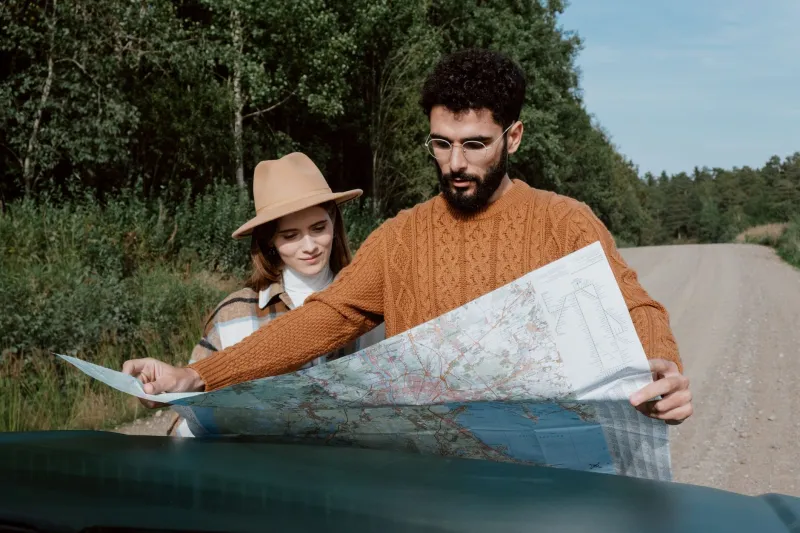
The travelers who come home with the most vivid memories, the most genuine connections, the most layered sense of a place? They're not always the ones with the best-researched itineraries. They're the ones who looked up from the map long enough to notice what was actually around them.
So the next time your GPS freezes, your reservation falls through, or you take the wrong exit off the highway and end up somewhere you didn't plan to be — don't immediately reach for the reroute button.
Look around first. Ask someone nearby what's worth seeing. Walk one block in a direction that feels interesting.
You might just find the best taqueria of your life.